

1.2K
Downloads
13
Episodes
Listen to potters and ceramic artists from around Australia as they share insights into their practice and some thoughts about ceramics in our daily lives.
Episodes
Jul 19, 2019
Jul 19, 2019
14 min
This conversation was recorded at the Australian Ceramics Triennale on 3 May 2019 at Princes Wharf One, Hobart, Tasmania, Australia.
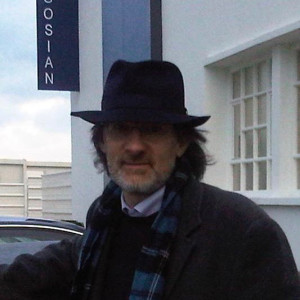
Barbara Campbell-Allen and Lou McCallum were joined by Jeff Malpas after his keynote address: A Potter, Two Philosophers, and 365 Jugs.
Jeff Malpas is Distinguished Professor at the University of Tasmania and Visiting Distinguished Professor at Latrobe University. He was founder, and until 2005, Director, of the University of Tasmania’s Centre for Applied Philosophy and Ethics. He is the author and/or editor of 21 books with some of the world’s leading academic presses, and has published over 100 scholarly articles on topics in philosophy, art, architecture, and geography.
His work is grounded in post-Kantian thought, especially the hermeneutical and phenomenological traditions, as well as in analytic philosophy of language and mind, and draws on the thinking of a diverse range of thinkers including, most notably, Albert Camus, Donald Davidson, Martin Heidegger, and Hans-Georg Gadamer. He is currently working on topics including the ethics of place, the failing character of governance, the materiality of memory, the topological character of hermeneutics, the place of art, and the relation between place, boundary, and surface.
Jul 19, 2019
Jul 19, 2019
15 min
This conversation was recorded at the Australian Ceramics Triennale on 2 May 2019 at Princes Wharf One, Hobart, Tasmania, Australia.
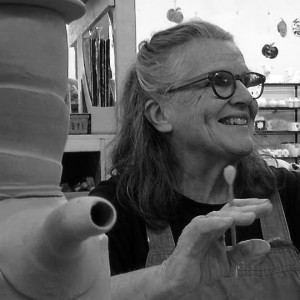
Lou McCallum was joined by Jane Sawyer and Janet DeBoos after their presentation, The Future Distributed Studio.
www.slowclay.com
www.aic-iac.org/en/member/janet-de-boos/
In 2006, ceramic artist and educator Janet DeBoos presented a paper at the Brisbane Ceramics Triennale entitled "The Distributed Studio" where she predicted a few changes that have since come to pass: the reduction in funding for courses offering ceramics at tertiary institutions, the need for other forms of training to fill the gaps and the necessary connected state of these future entities to work together. There were some amusing references to rhizomes and dogs amongst other things but the paper’s prophesies have mostly come true.
Join Jane Sawyer and her guest Janet DeBoos for a lively discussion exploring the current and future opportunities available for ceramics skills training. Using Janet DeBoos’ "The Distributed Studio" as a foundation document for the discussion we invite Janet back with her crystal ball to discuss the question, what next?
Jane Sawyer established Slow Clay Centre in Melbourne in 2012 with no desire to fill any gaps. She was simply just responding to demand for her specialist teaching of advanced wheel techniques, influenced by her own training in Japan. However, in the intervening years the pressure to provide education that is wider and more encompassing and more connected to community has been a guiding force and she is interested to explore Janet DeBoos’ ideas for the future. Join us and help brainstorm our future!
Photo: Janet DeBoos
Jul 19, 2019
Jul 19, 2019
11 min
This conversation was recorded at the Australian Ceramics Triennale on 3 May 2019 at Princes Wharf One, Hobart, Tasmania, Australia.
Lou McCallum was joined by Jane Bamford after her presentation, The CSIRO Spotted Handfish Project.
www.janebamford.com
Jane began studying ceramics in Japan in 1993. She subsequently completed her BFA, majoring in Ceramics at the Tasmanian College of the Arts and was awarded the Deans’ roll of excellence. Jane was later selected as an Associate at the Jam Factory Craft and Design Centre in Adelaide and has worked in her own studio practice, educational facilities and exhibited throughout Australia and internationally. This year she was a finalist in the Waterhouse Natural Science Art Prize and successively undertook an Art/Science residency at UTAS School of Creative Arts.
Jane’s work is primarily informed from research and observation of the coastal, marine and alpine landscapes of Tasmania. This observation, connection to place and environmental awareness has led her to produce work on issues like climate change’s impact on Tasmanian marine environments and the reestablishment of Spotted Handfish spawning habitat.
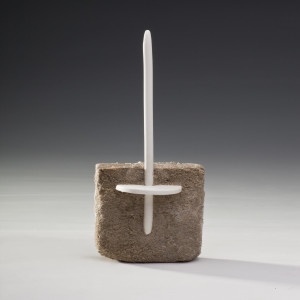
In 2018 Jane began a commission for the CSIRO to design and make 3000 ceramic artificial spawning habitat (ASH) for the Spotted Handfish (Brachionichthys hirsutus). These installations of ASH were SCUBA deployed to support this critically endangered marine species. Creating ceramic ASH is a significant project which intersects her ceramic art practice with current scientific research and practice. In September 2018 the Spotted Handfish’s first wild spawning around ceramic ASH was observed. It is rare that an arts practice has the opportunity to engage so directly with the natural environment in a manner that is beyond interpretive and has very real achievable positive ecological outcomes.